
Thursday, September 17, 2026

Good morning, I’m Steven with The Practical Trader™. Today’s stories offer three useful lessons about interest rates, index membership and the difference between strong demand and a company’s ability to meet it.
1. The Fed Raises Rates
U.S. stock futures rose after the Federal Reserve increased its benchmark interest rate to address persistent inflation. The decision removed one immediate uncertainty, but the Fed indicated that additional increases remain possible, with traders assigning roughly even odds to another hike in October. Source: Reuters
Why should a beginning trader care?
Higher rates can increase borrowing costs and make bonds more competitive with stocks. Technology shares may be especially sensitive because much of their valuation depends on profits expected far into the future.
The Practical Trader lesson
Markets can rise even after seemingly negative news when the outcome removes uncertainty. Watch whether today’s initial strength holds before concluding that investors have fully accepted the new rate outlook.
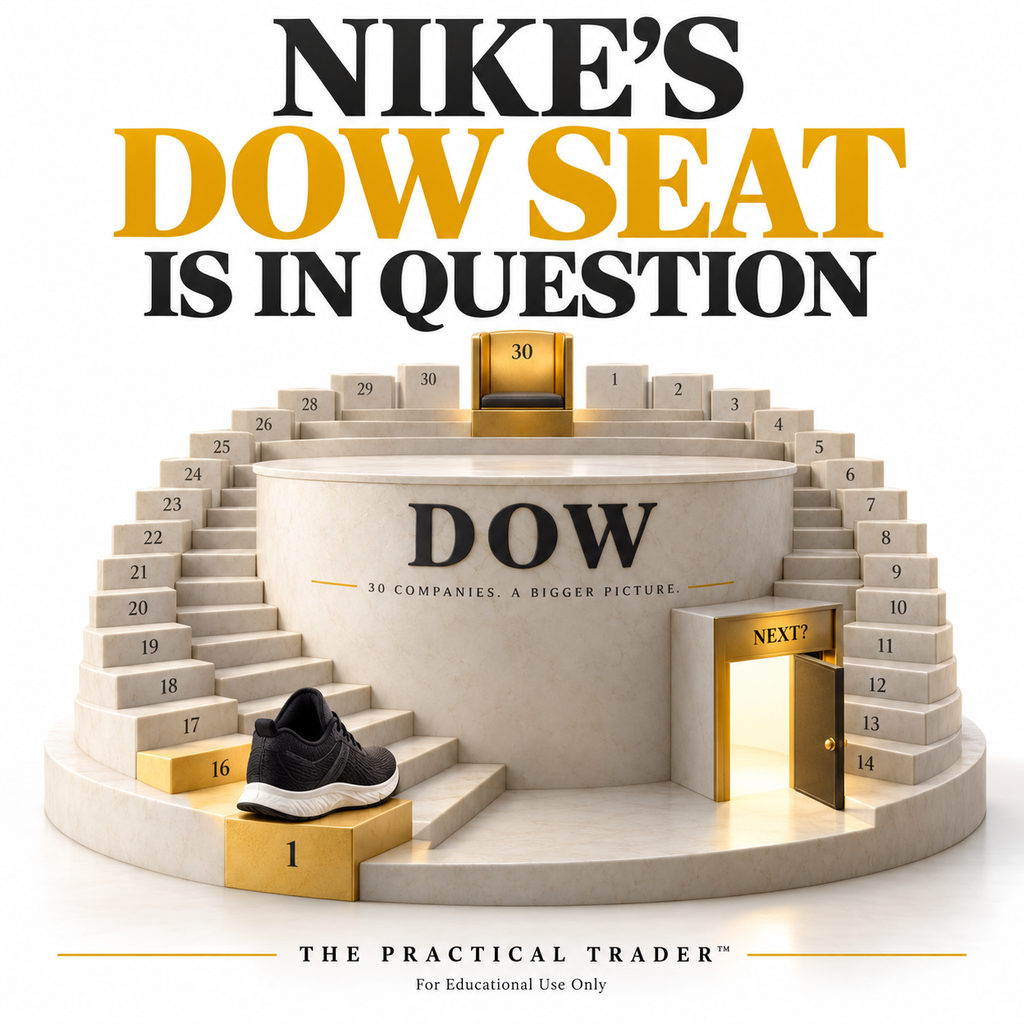
2. Nike’s Dow Seat Is in Question
Nike’s declining share price has reduced its influence in the price-weighted Dow Jones Industrial Average and raised questions about whether it could be removed from the 30-company index. Nike has lost approximately 80% of its market value over five years amid weak innovation, increasing competition and challenging consumer demand. Source: Reuters
Why should a beginning trader care?
The Dow gives greater influence to companies with higher share prices—not necessarily those with the largest total market values. Being removed from an index can also cause funds that follow that index to sell their shares.
The Practical Trader lesson
Index membership does not guarantee company quality or future performance. Examine the business trend, competitive position and turnaround evidence instead of relying on a famous name.

3. AI Demand Outruns Supply
Huawei said demand for its artificial-intelligence computing equipment in China is greater than its current production capacity. The company plans to accelerate new chip launches and connect large numbers of processors to create more powerful systems as it challenges Nvidia within China. Source: Reuters
Why should a beginning trader care?
Strong demand is encouraging, but sales remain limited when a company cannot manufacture enough products. Huawei’s expansion could also affect Nvidia, semiconductor suppliers and the broader competition between U.S. and Chinese technology ecosystems.
The Practical Trader lesson
Demand and supply must be evaluated together. Before treating a product shortage as completely positive, ask whether the company can increase production profitably and reliably.
Which of today’s three lessons would be most useful in your own research? Share your thoughts in the comments below.
Follow The Practical Trader™ on Facebook: https://www.facebook.com/ThePracticalTrader
For Educational Use Only. Not individualized financial advice.
Leave a Reply